
A deer collision can happen in seconds. What you do after the impact can affect your safety, your vehicle claim, and any injury claim involving another driver. The North Carolina Department of Transportation reported 63,487 animal-related crashes statewide from 2022 through 2024. NCDOT says most animal crashes involve deer, and deer activity rises sharply from October through December. During that same three-year period, Mecklenburg County recorded 1,321 animal-related crashes.
After a deer-related car accident, move out of traffic when you can do so safely, check for injuries, notify law enforcement when the crash is reportable or creates a roadway hazard, stay away from the animal, document the scene, notify your insurer, and get medical care when needed. A direct impact with a deer is commonly handled under other-than-collision coverage. A separate liability claim may arise when another driver rear-ends you, swerves into your lane, follows too closely, or otherwise contributes to the crash.
ClearView Legal helps injured drivers in Charlotte, North Carolina understand the insurance and liability issues that can follow a serious wildlife-related crash.

Why Deer Crashes Are a Bigger Fall Concern in North Carolina 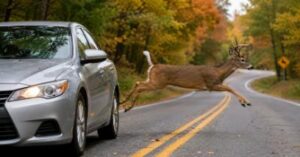
Fall creates a higher risk of animal-related crashes across North Carolina. NCDOT reports that deer movement increases during mating and hunting seasons, while limited daylight can make animals harder to see near the roadway.
NCDOT data for 2022 through 2024 shows 9,238 animal-related crashes in October, 14,725 in November, and 8,181 in December. Those three months accounted for just over half of the statewide three-year total. November alone accounted for about 23.2 percent of the total.
The risk is not limited to rural highways. White-tailed deer can move through wooded corridors, creek areas, fields, greenways, neighborhoods, and undeveloped parcels near busy roads. Drivers in Charlotte and Mecklenburg County can encounter deer in suburban areas as well as on rural routes.
NCDOT also warns that deer often travel in small groups. If you see one deer near the road, watch for others nearby.
What to Do Immediately After Hitting a Deer
Your first priority is preventing another collision. If your vehicle is operable and you can move it safely, get out of the travel lane and onto a shoulder, parking area, or another safer location. Turn on your hazard lights and check yourself and your passengers for injuries.
Then take these steps:
- Call 911 if anyone is injured, the crash is blocking traffic, the animal or debris creates an immediate roadway hazard, or the crash appears to meet North Carolina’s reporting requirements.
- Do not approach, touch, or try to move an injured deer. A frightened or wounded animal can be dangerous.
- If you can do so without entering traffic, photograph the vehicle damage, road, shoulder, debris, skid marks, lighting conditions, nearby signs, and the animal from a safe distance.
- Exchange insurance, vehicle, and contact information with any other driver involved.
- Get the names and contact information of witnesses.
- Save dash camera footage before the system records over it.
- Arrange for towing if vehicle damage makes continued driving unsafe.
- Notify your insurance company and keep the claim number and adjuster information.
North Carolina law requires a driver involved in a reportable crash to immediately notify the appropriate law enforcement agency. A reportable crash includes one involving injury or death, or total property damage of $1,000 or more. Vehicle damage can exceed $1,000 quickly, so the full repair cost may not be obvious at the roadside.
Do not approach an injured deer, and do not enter moving traffic to take photographs. Your safety and the safety of other drivers come first.
Attorney Paralegal
Marcel McCrea

Tylisa Crawford
Should You Swerve to Avoid a Deer?
NCDOT advises drivers not to swerve to avoid a deer. A sudden lane change can cause you to lose control, leave the roadway, cross into opposing traffic, hit a fixed object, or collide with another vehicle.
If you see a deer, reduce speed while maintaining control of the vehicle. If there is no clear escape path, an abrupt swerve can create a more dangerous crash than the original hazard.
After a collision, a driver’s reaction can become part of the liability investigation. If another driver sees a deer, moves sharply into your lane, and hits your vehicle, the animal may have created the emergency, but the driver’s response can still be examined. The same can be true when a following driver hits your vehicle after you slow or stop for a deer.
I have worked and referred cases to Attorney Marcel McCrea in Charlotte, North Carolina, for a number of years. His zealous advocacy, keen attention to details, and client care are particularly noteworthy. He has been especially helpful in some complicated personal injury matters that I have referred to his firm. I highly recommend Marcel McCrea and ClearView Legal for anyone looking for excellent attorneys.” - Frantz Jacques ClearView Legal do great work. When I had my car accident they were very diligent in showing me the process. They took care of all the necessary paperwork and negotiation in my personal injury claim. They were both passionate and determined to get me my settlement. I am eternally grateful. Definitely 5 star lawyers in my book." - Osmund Marcellin I was recently injured in a car accident. I hired Attorney Marcel McCrea of ClearView Legal in Charlotte, NC to help me with my personal injury matter and to recover for my medical bills, lost wages, and pain and suffering. - S. Jackson
Before hiring the firm, I tried to negotiate with the insurance company on my own and got no where. Marcel McCrea did an excellent job and helped me to recover much more than I expected. Marcel and his staff exceeded my expectations and provided great customer service. I highly recommend the firm!"
Who Pays for Damage After a Deer Accident?
When your vehicle directly strikes a deer, the damage is commonly handled under other-than-collision coverage. The North Carolina Department of Insurance identifies contact with an animal as a type of loss that can fall under other-than-collision coverage.
Your deductible, coverage limits, exclusions, and policy language still control what your insurer will pay.
The coverage analysis can change when you avoid the deer but hit another object. If you swerve and strike a guardrail, sign, tree, or another fixed object, the vehicle damage may be analyzed under collision coverage. If another driver hits your vehicle, that driver’s liability coverage may become relevant when the evidence supports negligence.
Give your insurer a clear factual account. Do not guess about speed, distance, fault, or injuries. Ask for the claim number, the adjuster’s contact information, and a written explanation if coverage is denied or limited.
For more information about motor vehicle injury claims, visit ClearView Legal’s Charlotte car accident lawyers page:
https://clearview.legal/charlotte-car-accident-lawyers/
When Another Driver May Be Responsible
A deer-related crash is not always a one-vehicle event. Another driver’s conduct may create a personal injury claim even when wildlife triggered the first reaction.
Examples can include a driver who:
- Rear-ends your vehicle after you brake for a deer.
- Crosses the center line while trying to avoid an animal.
- Changes lanes without checking for another vehicle.
- Drives too fast for visibility, roadway, or traffic conditions.
- Follows too closely to respond safely.
- Is distracted and fails to react to slowing traffic.
North Carolina follows a contributory negligence rule. In a disputed injury claim, an insurer may argue that your own conduct contributed to the collision. The outcome depends on the facts, the evidence, and the legal rules that apply to the claim.
Photographs, witness accounts, dash camera footage, nearby video, vehicle data, damage patterns, and the sequence of events can all matter when fault is disputed.
A passenger injured in a deer-related crash may face a different liability analysis because the passenger usually had no control over either driver’s decisions. Each claim depends on its own facts.
For broader information about injury claims, visit ClearView Legal’s Charlotte personal injury attorneys page:
https://clearview.legal/charlotte-personal-injury-attorneys/
Get Medical Care and Track Your Symptoms
A deer collision can cause neck, back, shoulder, head, chest, and other injuries, particularly when airbags deploy, the vehicle leaves the roadway, or another vehicle becomes involved.
If you have concerning symptoms, seek appropriate medical care. Tell the provider how the crash happened and describe your symptoms accurately. Follow the treatment recommendations that are appropriate for your medical needs.
Keep copies of:
- Medical records.
- Bills and receipts.
- Prescription information.
- Work restrictions.
- Mileage related to medical visits.
- Written instructions from medical providers.
Accurate records can help document the connection between the collision, your injuries, your treatment, and any financial losses related to the crash.
You can also review ClearView Legal’s car accident video library:
https://clearview.legal/video-library/car-accident-videos/
Evidence That Can Matter Later
A deer accident can look simple at the scene and become disputed later. One driver may claim that another vehicle moved across a lane. An insurer may question how the collision happened. Vehicle damage may also become relevant when the accounts conflict.
Useful evidence can include:
- Photographs and video from the scene.
- The law enforcement crash report.
- Witness names and contact information.
- Dash camera footage.
- Nearby business or residential security footage.
- Vehicle event data when available and relevant.
- Repair estimates and repair records.
- Tow records.
- Medical records.
- Insurance communications.
Write down what you remember while the details are fresh. Note where the deer came from, what lane you occupied, when you first saw the animal, what nearby vehicles did, and where each impact occurred.
Avoid posting crash details, photographs, or theories about fault on social media while an insurance or injury claim is pending.
How Long Do You Have to Bring a North Carolina Injury Claim?
North Carolina law generally provides a three-year limitations period for many personal injury actions. Different rules can apply to claims involving minors, wrongful death, government entities, or other special circumstances.
The filing deadline does not mean that you should delay an investigation. Dash camera footage can be overwritten, security video can be deleted, vehicles can be repaired, and witnesses can become harder to locate.
You can learn more about attorney Marcel McCrea here:
https://clearview.legal/charlotte-attorney-marcel-mccrea/
How a Car Accident Attorney Can Help
A car accident attorney can help separate the wildlife event from the legal and insurance issues that followed it.
Depending on the facts, legal assistance can include:
- Reviewing available insurance coverage.
- Obtaining and reviewing the crash report.
- Locating witnesses.
- Preserving video and other evidence.
- Reviewing vehicle damage and the sequence of impacts.
- Evaluating another driver’s conduct.
- Documenting injuries and financial losses.
- Communicating with insurance companies.
- Responding to disputed-fault arguments.
Not every deer collision creates a lawsuit. Many direct deer strikes are handled as first-party vehicle claims. Legal guidance can become more useful when you are injured, another vehicle is involved, fault is disputed, an insurer denies or limits coverage, or the crash causes significant medical or financial consequences.
Talk With a Charlotte Car Accident Lawyer After a Serious Deer Crash
If a deer-related car accident in Charlotte, North Carolina leaves you injured or raises questions about another driver’s responsibility, ClearView Legal can review the circumstances and explain the insurance and legal issues that may apply.
ClearView Legal serves injured people in Charlotte, Mecklenburg County, and nearby North Carolina communities. The firm emphasizes clear, candid communication and a client-focused approach.
Call 980-300-6223 or visit:
https://clearview.legal/contact-us/
This article is for informational purposes only and is not legal advice. Consult an attorney about your specific situation.

 |
 |