
If you are injured at a tailgate or in a stadium parking lot in Charlotte, North Carolina, more than one person or business may be responsible. Your claim may involve a negligent driver, a dangerous property condition, temporary traffic controls, a parking operator, an event contractor, another tailgater, or a combination of parties.
The cause of your injury matters. A vehicle collision may lead to a motor vehicle negligence claim. A fall caused by broken pavement, a loose cable, poor lighting, or an unsafe temporary setup may involve premises liability. An injury caused by crowd control or security failures may require a different analysis.
North Carolina law also makes fault especially significant because contributory negligence can bar recovery in a negligence claim when your own negligence proximately contributed to the injury, subject to limited legal doctrines that may apply in some cases. Prompt action can help preserve surveillance video, photographs, witness information, parking records, incident reports, and other evidence before it is lost or overwritten.
ClearView Legal helps injured people in Charlotte and nearby North Carolina communities evaluate personal injury claims and identify the parties and insurance coverage that may be involved.
Learn more about Charlotte personal injury claims:
https://clearview.legal/charlotte-personal-injury-attorneys/

Why Can Tailgating and Stadium Parking Lot Accidents Be Legally Complicated? 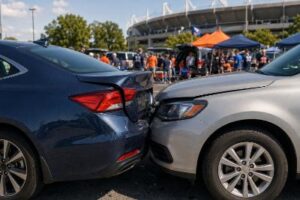
A stadium parking lot injury is not automatically a premises liability case. Depending on what happened, your claim may involve motor vehicle negligence, pedestrian injury law, premises liability, negligent security, or several legal theories at the same time.
Common examples include:
- A driver backs out without checking for pedestrians.
- A vehicle moves too quickly through a crowded tailgating lane.
- A pedestrian is struck while crossing between parked vehicles.
- A guest trips over a broken wheel stop, pothole, cord, cable, cooler, tent stake, or other obstruction.
- A temporary traffic pattern places pedestrians and vehicles in the same narrow area.
- Poor lighting contributes to a collision or fall after an evening event.
- A contractor creates an unsafe walkway while setting up barricades, equipment, or temporary structures.
- Another tailgater creates a dangerous condition that causes an injury.
Each situation requires a fact-specific investigation. You may need to determine who owned the lot, who operated it on the event date, who controlled traffic, who maintained the area, and whether a separate company handled security, lighting, cleanup, or temporary equipment.
Who May Be Responsible After a Tailgating or Parking Lot Injury?
A Negligent Driver
If a driver causes a crash or strikes you while you are walking through a parking lot, the claim may proceed much like another North Carolina motor vehicle accident claim. Evidence may include vehicle positions, damage patterns, witness statements, surveillance footage, photographs, police documentation, and insurance records.
Crowded event lots create unusual visibility and traffic problems. Large vehicles, tents, equipment, and groups of pedestrians may limit sight lines. Those conditions do not eliminate a driver’s duty to use reasonable care.
Learn more about Charlotte car accident claims:
https://clearview.legal/charlotte-car-accident-lawyers/
Learn more about Charlotte pedestrian accident claims:
https://clearview.legal/charlotte-pedestrian-accident-attorneys/
Attorney Paralegal
Marcel McCrea

Tylisa Crawford
The Property Owner or Occupier
A property owner or occupier in North Carolina generally owes lawful visitors a duty to exercise reasonable care in maintaining the property. A premises liability claim may arise when a responsible party creates a dangerous condition or knows, or reasonably should know, about a dangerous condition and fails to correct it or provide an adequate warning.
A fall on stadium or parking property does not automatically establish liability. You still need evidence that connects the unsafe condition to your injury and shows why the responsible party may be legally at fault.
Potential hazards can include:
- Broken or uneven pavement
- Damaged curbs or wheel stops
- Loose cables or cords
- Debris in walking areas
- Poorly placed tents, barriers, or temporary structures
- Inadequate lighting
- Unsafe pedestrian routes
- Unmarked changes in elevation
Learn more about Charlotte slip and fall claims:
https://clearview.legal/charlotte-slip-and-fall-attorneys/
An Event Organizer, Parking Operator, or Contractor
Large sporting events, concerts, festivals, and community events often involve several companies with different responsibilities. One entity may own the property, another may operate the parking lot, and separate contractors may manage traffic, security, lighting, cleanup, barricades, or temporary event equipment.
Liability may depend on who controlled the area where you were injured and what duties that party accepted. Contracts, staffing records, inspection logs, parking plans, traffic plans, event procedures, and maintenance records may help identify the responsible parties.
The name printed on your parking pass does not always identify every person or company that may have legal responsibility.
I have worked and referred cases to Attorney Marcel McCrea in Charlotte, North Carolina, for a number of years. His zealous advocacy, keen attention to details, and client care are particularly noteworthy. He has been especially helpful in some complicated personal injury matters that I have referred to his firm. I highly recommend Marcel McCrea and ClearView Legal for anyone looking for excellent attorneys.” - Frantz Jacques ClearView Legal do great work. When I had my car accident they were very diligent in showing me the process. They took care of all the necessary paperwork and negotiation in my personal injury claim. They were both passionate and determined to get me my settlement. I am eternally grateful. Definitely 5 star lawyers in my book." - Osmund Marcellin I was recently injured in a car accident. I hired Attorney Marcel McCrea of ClearView Legal in Charlotte, NC to help me with my personal injury matter and to recover for my medical bills, lost wages, and pain and suffering. - S. Jackson
Before hiring the firm, I tried to negotiate with the insurance company on my own and got no where. Marcel McCrea did an excellent job and helped me to recover much more than I expected. Marcel and his staff exceeded my expectations and provided great customer service. I highly recommend the firm!"
Another Tailgater, Vendor, or Guest
Some injuries are caused by another person rather than the property itself. For example, another tailgater may leave a grill, tent line, cooler, cable, or other object in a walking path. A vendor may create a hazardous setup. A guest may move equipment into a traffic lane or pedestrian area.
Whether another person may be liable depends on the facts, including what that person did, whether the conduct created an unreasonable risk, and whether that conduct caused your injury.
A Security Provider or Other Responsible Party
Some stadium and tailgating injuries involve crowd management or security rather than a defective walking surface. If inadequate security contributes to a foreseeable injury, the facts may support a negligent security analysis.
Relevant evidence may include prior incidents, staffing decisions, security procedures, video, incident reports, warnings, and the way the area was monitored or controlled.
Learn more about Charlotte negligent security claims:
https://clearview.legal/charlotte-negligent-security-attorneys/
What Should You Do After a Stadium Parking Lot Accident?
Your health should come first. Seek medical care when you are injured or develop symptoms after the incident. Some injuries become more noticeable after swelling, stiffness, pain, or other symptoms develop. Medical records can also document your condition, evaluation, and recommended treatment.
If you can act safely, preserve evidence before the parking lot is cleared, cleaned, or reconfigured.
- Photograph the accident area from several angles.
- Photograph vehicle positions, pavement, lighting, barriers, tents, cables, equipment, or other relevant conditions.
- Photograph visible injuries when appropriate.
- Obtain names and contact information for witnesses.
- Keep your event ticket, parking receipt, digital parking confirmation, or parking pass.
- Report the incident to police, venue staff, parking management, or security when appropriate.
- Ask how you can obtain a copy of any incident report.
- Save photographs, videos, text messages, emails, medical records, bills, receipts, and insurance correspondence.
- Avoid making broad statements about fault before you understand what happened.
- Avoid detailed social media posts about the accident, your injuries, or your recovery while a claim is being evaluated.
Video can be especially valuable after a stadium parking lot injury. Venues, parking operators, nearby businesses, rideshare areas, security systems, and private vehicles may have recordings. Some systems overwrite recordings on short schedules.
Evidence from a stadium parking lot can disappear quickly because vehicles move, temporary barriers are removed, tailgating equipment is packed away, and surveillance footage may be overwritten.
How Can North Carolina Contributory Negligence Affect Your Claim?
North Carolina follows the contributory negligence rule in ordinary negligence cases. If your own negligence proximately contributed to your injury, contributory negligence may bar you from recovering damages.
In a parking lot or tailgating claim, an insurance company may argue that you:
- Entered a moving traffic lane without looking.
- Ignored a marked pedestrian route.
- Walked through a restricted area.
- Failed to notice an open and obvious condition.
- Were distracted at the time of the incident.
- Used alcohol in a way that allegedly contributed to the injury.
An allegation does not establish contributory negligence by itself. The facts, evidence, causation, and applicable law still control the analysis.
North Carolina also recognizes the last clear chance doctrine in certain cases. When its legal requirements are met, the doctrine may allow recovery despite a plaintiff’s contributory negligence. Whether it applies depends heavily on the facts.
Because fault can become a central issue, use care when giving recorded statements or signing documents for an insurance company before you understand the circumstances of the accident.
What Compensation May Be Available After a Parking Lot Injury?
If you prove a valid personal injury claim, you may be able to seek compensation for losses caused by the accident. The available damages depend on the facts and evidence.
Potential damages may include:
- Past and future medical expenses
- Lost wages
- Reduced earning capacity
- Physical pain and suffering
- Scarring or permanent impairment
- Property damage
- Other accident-related out-of-pocket losses
The value of a claim depends on factors such as injury severity, medical treatment, work restrictions, long-term effects, insurance coverage, disputed fault, and the strength of the supporting evidence.
No attorney can responsibly promise a specific settlement or verdict.
How Long Do You Have to File a Personal Injury Claim in North Carolina?
North Carolina General Statutes Section 1-52 generally provides a three-year limitations period for personal injury actions. In many accident cases, the period begins when the bodily injury becomes apparent or reasonably should have become apparent.
The exact deadline can vary based on the type of claim and the parties involved. Different procedures or deadlines may apply when a government entity is involved or when the claim is based on a different cause of action.
Waiting can also make a claim harder to investigate. Witness memories can fade, video can be overwritten, records can become harder to locate, and physical conditions can change.
What If the Accident Happened at a Charlotte Sports or Concert Venue?
The legal analysis does not depend on whether you were attending a professional football game, college event, concert, festival, or community gathering. The main questions usually concern duty, control, negligence, causation, damages, and available defenses.
A Charlotte venue accident may involve:
- Privately owned property
- Contracted parking services
- Temporary traffic control
- Private security
- Vendors
- Event organizers
- Public streets near the venue
- Multiple insurance policies
An attorney may review parking agreements, incident reports, contracts, traffic plans, photographs, surveillance footage, witness statements, maintenance records, and insurance information to determine which parties may be involved.
Frequently Asked Questions
Can You Have a Claim If No Vehicle Hit You?
Yes, depending on the facts. A dangerous walking surface, unsafe temporary setup, poor lighting, loose cable, improperly placed equipment, or another property condition may support a premises liability claim if you can prove the required legal elements.
Can More Than One Party Be Responsible?
Yes. A driver, property owner, parking operator, event organizer, contractor, security company, vendor, tailgater, or another party may have responsibility for the circumstances that caused your injury. More than one insurance policy may also require review.
What If You Were Tailgating Before the Accident?
Tailgating by itself does not decide liability. The key question is what caused your injury and whether any person’s conduct contributed to it. Alcohol use, pedestrian behavior, driver conduct, property conditions, temporary setups, and event management may become relevant depending on the facts.
What If the Parking Lot Was Temporary or Operated Only for the Event?
Temporary parking areas can create added questions about control and maintenance. You may need to identify the property owner, event organizer, parking operator, traffic contractor, or other party that controlled the area on the date of the event.
Should You Give the Insurance Company a Recorded Statement?
You should use caution. An insurer may ask detailed questions about where you were walking, what you saw, whether you had consumed alcohol, what footwear you had on, and what you did immediately before the incident. Because North Carolina contributory negligence can make fault disputes especially significant, consider obtaining legal advice before giving a broad recorded statement.
Speak With a Charlotte Parking Lot Injury Attorney
If you were injured while tailgating, walking through a stadium parking lot, or attending an event in Charlotte, North Carolina, you may have questions about who was responsible and which insurance coverage may apply.
ClearView Legal offers free consultations to injured people in Charlotte and nearby North Carolina communities. The firm emphasizes consistent, clear, candid communication while helping clients evaluate personal injury claims.
Call (980) 300-6223 or visit:
https://clearview.legal/contact-us/
This article is for informational purposes only and is not legal advice. Every case is different. Speak with an attorney about your specific circumstances.

 |
 |