
Summary
A driver may be liable for hitting a cyclist after dark in North Carolina when careless driving, such as speeding, distracted driving, unsafe passing, or failing to keep a proper lookout, causes the collision. Nighttime bicycle crashes can become more complicated when questions arise about whether the cyclist had the lighting or visibility equipment required by North Carolina law.
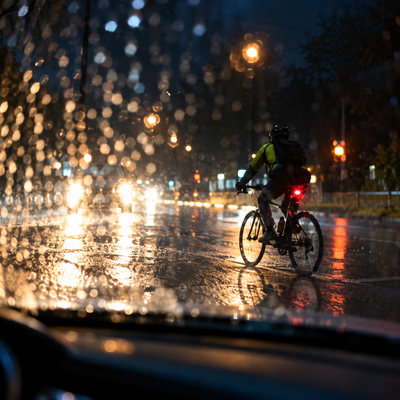
North Carolina also follows contributory negligence principles. An insurance company may argue that a cyclist’s own conduct contributed to the crash and bars recovery. That makes evidence about visibility, driver behavior, road conditions, and bicycle equipment especially significant.
ClearView Legal helps injured cyclists in Charlotte, North Carolina, and nearby areas understand how traffic laws, physical evidence, insurance coverage, and disputed fault may affect a bicycle accident claim.
Liability after a nighttime bicycle crash rarely depends on one fact. An investigation may examine the driver’s speed and attention, the cyclist’s lights and rear visibility equipment, street lighting, road design, sight distance, camera footage, witness statements, weather when relevant, and the positions of the vehicle and bicycle before impact.




How North Carolina Law Treats Cyclists on the Road
North Carolina traffic law generally gives bicyclists the rights and duties that apply to drivers of vehicles when those rules can reasonably apply to bicycle travel.
Both a driver and a cyclist may have legal responsibilities leading up to a crash.
Drivers may be expected to:
- Keep a proper lookout.
- Control their speed.
- Follow traffic signals and signs.
- Use reasonable care when approaching or passing a cyclist.
- Avoid unsafe lane changes, turns, and passing movements.
Cyclists may also be required to follow applicable traffic rules concerning the direction of travel, traffic controls, signaling, and nighttime equipment.
A cyclist does not lose the right to use the road because it is dark. Drivers must still watch for bicycles and operate with reasonable care under the conditions.
People injured while riding in Charlotte can learn more about bicycle accident claims here:
https://clearview.legal/charlotte-bicycle-accident-attorneys/

Marcel McCrea
Attorney

Tylisa Crawford
Paralegal
What Lights Must a Cyclist Use After Dark in North Carolina?
North Carolina General Statutes Section 20-129(e) sets nighttime equipment requirements for bicycles operated on public streets, public vehicular areas, and public greenways.
A bicycle operated at night must have a reflex mirror on the rear. It must also have:
- A lighted front lamp that is visible under normal atmospheric conditions from at least 300 feet in front of the bicycle.
- Either a rear lamp that emits a red light visible from at least 300 feet behind the bicycle, or clothing or a vest worn by the rider that is bright and visible from at least 300 feet behind the bicycle.
These requirements can become a major issue when an insurer or defense attorney disputes fault.
If the cyclist had the required front lamp, rear reflex mirror, and qualifying rear light or visible clothing, that evidence may help show that the rider could have been seen by an attentive driver.
If the bicycle or rider did not meet the nighttime equipment requirements, the driver’s insurer may argue that limited visibility contributed to the collision.
A lighting violation does not automatically prove that the driver used reasonable care. Driver conduct and the circumstances of the crash still need to be evaluated.

I have worked and referred cases to Attorney Marcel McCrea in Charlotte, North Carolina, for a number of years. His zealous advocacy, keen attention to details, and client care are particularly noteworthy. He has been especially helpful in some complicated personal injury matters that I have referred to his firm. I highly recommend Marcel McCrea and ClearView Legal for anyone looking for excellent attorneys.”
- Frantz Jacques
ClearView Legal do great work. When I had my car accident they were very diligent in showing me the process. They took care of all the necessary paperwork and negotiation in my personal injury claim. They were both passionate and determined to get me my settlement. I am eternally grateful. Definitely 5 star lawyers in my book."
- Osmund Marcellin
I was recently injured in a car accident. I hired Attorney Marcel McCrea of ClearView Legal in Charlotte, NC to help me with my personal injury matter and to recover for my medical bills, lost wages, and pain and suffering.
Before hiring the firm, I tried to negotiate with the insurance company on my own and got no where. Marcel McCrea did an excellent job and helped me to recover much more than I expected. Marcel and his staff exceeded my expectations and provided great customer service. I highly recommend the firm!"
- S. Jackson
When Can a Driver Be Liable for Hitting a Cyclist at Night?
A driver may be legally responsible when negligent driving causes a nighttime bicycle collision.
Examples of conduct that may support a negligence claim include:
- Looking at a phone instead of watching the road.
- Driving too fast for the available visibility or roadway conditions.
- Following a cyclist too closely.
- Failing to use required vehicle lights.
- Passing a bicycle without adequate clearance.
- Turning across a cyclist’s path.
- Failing to check mirrors before changing lanes or turning.
- Driving while impaired.
- Driving while dangerously fatigued.
- Failing to react when a cyclist was visible for enough time to avoid the collision.
North Carolina law also addresses certain passes of bicycles in areas where passing is otherwise prohibited. Under G.S. 20-150(e), a driver may pass a bicycle in a marked no-passing area only when all statutory conditions are satisfied. Among those conditions, the driver must either provide at least four feet between the motor vehicle and bicycle or completely enter the left lane.
An investigation may examine whether the driver passed too closely, drifted into the cyclist’s path, or attempted a pass when the roadway did not allow enough room for a safe maneuver.
A cyclist struck by a passenger vehicle may also find related information here:
https://clearview.legal/charlotte-car-accident-lawyers/
Can a Cyclist Be Considered Partly at Fault?
Yes. A cyclist can be accused of contributing to a crash.
North Carolina uses contributory negligence principles rather than the comparative negligence system used by many states. A defendant may argue that the injured person’s own negligence contributed to the injury and bars recovery.
An insurance company may investigate whether the cyclist:
- Had the required nighttime equipment.
- Used a rear light or qualifying visible clothing.
- Rode with the direction of traffic.
- Followed traffic lights and stop signs.
- Entered the roadway unexpectedly.
- Made a sudden turn or movement.
- Properly signaled when a signal was required.
- Used reasonable care under the circumstances.
An allegation of contributory negligence is not a final determination. The evidence must be evaluated to determine what happened and whether the cyclist’s conduct legally contributed to the collision.
Because contributory negligence can have a serious effect on a North Carolina injury claim, evidence showing how the collision occurred can be critical.
What Happens If the Cyclist Did Not Have Proper Lights?
Failure to use required nighttime bicycle equipment can make a claim more difficult, but it does not end the liability analysis by itself.
Consider a hypothetical Charlotte crash.
A cyclist is riding after dark without a working rear light. A driver approaches from behind while traveling substantially above the speed limit and looking down at a phone. The driver strikes the cyclist.
The driver’s insurance company may focus on the missing rear light and argue that the cyclist was difficult to see.
The cyclist may have evidence showing that streetlights illuminated the roadway, the driver’s headlights provided a clear view, the vehicle was speeding, and the driver was distracted before impact.
Those facts need to be considered together.
Now consider a different example.
A cyclist has a working front lamp, a red rear lamp, and the required rear reflex mirror. The rider is also wearing bright clothing. A driver turns across the cyclist’s path at an intersection and causes a collision.
Evidence showing that the cyclist was visible may help challenge an argument that the driver could not see the bicycle.
Nighttime bicycle cases depend heavily on their specific facts. Visibility evidence and driver conduct often need to be examined together.
What Evidence Can Help Establish Liability?
Evidence can disappear quickly after a bicycle collision.
When it can be done safely, preserving evidence may help clarify fault and respond to later disputes.
Potentially useful evidence may include:
- Photographs of the bicycle and vehicle.
- Photographs of the bicycle’s front lamp, rear lamp, and rear reflex mirror.
- Images of the clothing worn during the crash.
- Video from nearby businesses, homes, or traffic cameras.
- Dashcam footage.
- Witness names and contact information.
- Police crash reports.
- Vehicle event data when available.
- Phone records when distracted driving is suspected.
- Measurements of the roadway and available sight distance.
- Information about operating streetlights.
- Photographs showing the driver’s likely viewpoint.
- Medical records.
- GPS or cycling computer data.
- Fitness tracker information.
- Receipts or records for bicycle lighting equipment.
The damaged bicycle itself may also provide useful evidence. A broken rear lamp, damaged reflex mirror, bent wheel, crushed frame, or impact mark may help investigators evaluate the angle and location of the collision.
ClearView Legal’s bicycle accident video library provides related information:
https://clearview.legal/video-library/bicycle-accident-videos/
Why Visibility Evidence Matters After Dark
Many nighttime bicycle claims involve a dispute about what the driver could reasonably have seen.
An insurer may argue that the cyclist appeared too late for the driver to react. The cyclist may contend that the bicycle was visible long enough for an attentive driver to slow, change position, or avoid the collision.
An investigation may examine:
- Whether the road was straight or curved.
- Whether trees, parked vehicles, signs, or buildings blocked the driver’s view.
- Whether streetlights were operating.
- Whether the vehicle’s headlights were working properly.
- The vehicle’s speed.
- The cyclist’s position on the roadway.
- The brightness and placement of bicycle lights.
- The cyclist’s clothing.
- Whether surrounding traffic affected visibility.
- How far the driver traveled before impact.
Video footage, photographs, measurements, and accident reconstruction evidence may help clarify these questions.
What Compensation May Be Available After a Bicycle Crash?
When another party is legally responsible for a bicycle accident and the claim is not barred by a valid defense, an injured cyclist may seek compensation for losses caused by the collision.
Depending on the facts, recoverable damages may include:
- Emergency medical treatment.
- Hospital expenses.
- Surgery.
- Physical therapy.
- Future medical care.
- Lost wages.
- Reduced future earning capacity.
- Pain and suffering.
- Permanent impairment.
- Scarring.
- Bicycle repair or replacement.
- Damage to personal property.
Serious bicycle crashes can cause head injuries, fractures, spinal injuries, shoulder injuries, knee injuries, nerve damage, and other conditions that may require significant medical treatment.
The value of a claim depends on the injuries, medical evidence, lost income, insurance coverage, liability evidence, and other case-specific facts.
More information about injury claims is available here:
https://clearview.legal/charlotte-personal-injury-attorneys/
How Long Does a Cyclist Have to File a Lawsuit?
North Carolina generally applies a three-year statute of limitations to many personal injury claims. The correct deadline can vary based on the circumstances, the identity of the defendant, and the legal theory involved.
A filing deadline is not the only reason to act promptly.
Surveillance systems may overwrite video. Witnesses may become harder to locate. Vehicles can be repaired. Damaged bicycles may be discarded. Road conditions and lighting may change.
Nighttime bicycle cases can depend heavily on visibility evidence, so early preservation may protect information that cannot be recreated later.
What Should an Injured Cyclist Do After a Nighttime Crash?
Medical care should come first.
Cyclists can suffer significant injuries even when symptoms are not immediately obvious. Head injuries, fractures, internal injuries, and soft tissue injuries may become more apparent after the collision.
When circumstances allow, an injured cyclist should consider:
- Seeking appropriate medical treatment.
- Photographing the bicycle, vehicle, roadway, and lighting conditions.
- Identifying witnesses.
- Saving damaged lights, clothing, helmets, and other equipment.
- Preserving video or electronic data when available.
- Keeping medical records and expense information.
- Avoiding disposal or repair of the bicycle before relevant evidence is documented.
- Being careful when giving detailed statements to an insurance company before understanding how North Carolina contributory negligence law may affect the claim.
How an Attorney Can Help With a Nighttime Bicycle Accident Claim
A bicycle accident attorney can investigate whether driver negligence, cyclist conduct, roadway conditions, or a combination of factors contributed to the crash.
An investigation may involve:
- Reviewing the police report.
- Obtaining available video.
- Examining the bicycle and vehicle damage.
- Documenting lighting and roadway conditions.
- Interviewing witnesses.
- Reviewing applicable traffic laws.
- Requesting available insurance information.
- Evaluating allegations of contributory negligence.
- Documenting injuries and financial losses.
An attorney can also communicate with insurers, help preserve evidence, evaluate damages, and explain the legal options available under the facts.
Speak With a Charlotte Bicycle Accident Attorney
If a driver hit you while you were cycling after dark in Charlotte or another North Carolina community, ClearView Legal can review the circumstances and explain how bicycle equipment rules, driver negligence, insurance coverage, and contributory negligence may affect your options.
ClearView Legal represents injury clients in Charlotte, North Carolina, and nearby areas. Call to discuss your situation.
You can also contact the firm here:
https://clearview.legal/contact-us/
This article is for informational purposes only and is not legal advice. Every case depends on its specific facts. Speak with an attorney about your individual circumstances.