
Yes. Poor parking lot lighting can help support a negligent security claim in Charlotte, North Carolina, if the circumstances show that a property owner or another responsible party failed to take reasonable precautions against foreseeable criminal harm. A dark parking lot alone does not establish liability. You generally need evidence of a legal duty, a breach of that duty, causation, and damages.
If you were injured in a parking lot assault, the Charlotte negligent security attorneys at ClearView Legal can assess the property conditions, prior safety concerns, and records that may affect your claim.



How Can Inadequate Parking Lot Lighting Create Security Risks?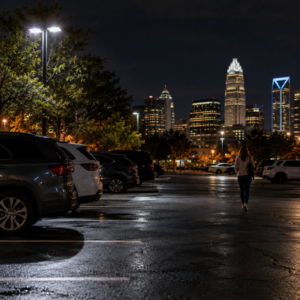
Parking areas at shopping centers, apartment complexes, hotels, offices, and garages can expose pedestrians to risks when visibility is limited. Poor lighting may make it harder to recognize a threat, see an approaching person, identify a witness, or find a safe exit.
Lighting concerns worth documenting include:
- Broken overhead lights or fixtures that do not turn on.
- Dark walkways between parking spaces and building entrances.
- Stairwells, elevators, or garage levels with inadequate illumination.
- Trees, walls, or other structures that obstruct installed lights.
- Repeated lighting complaints followed by delayed repairs.
- Areas where working lights fail to illuminate common pedestrian routes.
The presence of one or more of these conditions may justify an investigation. Whether the condition supports a legal claim depends on foreseeability, the owner’s responsibilities, and the connection between the condition and your injuries.

Marcel McCrea
Attorney

Tylisa Crawford
Paralegal
What Is a Negligent Security Claim in North Carolina?
A negligent security claim is a premises liability claim alleging that someone responsible for property safety failed to take reasonable measures against foreseeable criminal conduct. Property owners are not automatically responsible for every crime that occurs on their premises.
In Foster v. Winston-Salem Joint Venture, 303 N.C. 636 (1981), the North Carolina Supreme Court addressed an assault in a shopping mall parking lot. The court explained that the foreseeability of third-party criminal acts may create a duty to take reasonable precautions. The evidence included prior reported crimes and the security arrangements at the property.
The decision does not mean that every dark parking lot creates liability. It shows why information available to the property owner before an attack matters.
What Must You Prove in a Poor Parking Lot Lighting Negligent Security Claim?
Your claim generally requires proof of four elements:
- Duty of care. The defendant owed you a legal duty under the circumstances, taking into account your status on the property and the defendant’s responsibilities.
- Breach of duty. The defendant failed to exercise reasonable care, potentially by leaving known lighting problems unresolved despite a foreseeable security risk.
- Causation. The unreasonable security condition contributed legally and factually to the assault-related injuries. You need more than proof that the area was dark.
- Damages. You sustained legally recognized losses, such as medical expenses, lost income, pain, or emotional suffering.
Poor lighting is potential evidence, not automatic proof of negligence. A successful claim also depends on foreseeable danger, unreasonable precautions, and causation.

I have worked and referred cases to Attorney Marcel McCrea in Charlotte, North Carolina, for a number of years. His zealous advocacy, keen attention to details, and client care are particularly noteworthy. He has been especially helpful in some complicated personal injury matters that I have referred to his firm. I highly recommend Marcel McCrea and ClearView Legal for anyone looking for excellent attorneys.”
- Frantz Jacques
ClearView Legal do great work. When I had my car accident they were very diligent in showing me the process. They took care of all the necessary paperwork and negotiation in my personal injury claim. They were both passionate and determined to get me my settlement. I am eternally grateful. Definitely 5 star lawyers in my book."
- Osmund Marcellin
I was recently injured in a car accident. I hired Attorney Marcel McCrea of ClearView Legal in Charlotte, NC to help me with my personal injury matter and to recover for my medical bills, lost wages, and pain and suffering.
Before hiring the firm, I tried to negotiate with the insurance company on my own and got no where. Marcel McCrea did an excellent job and helped me to recover much more than I expected. Marcel and his staff exceeded my expectations and provided great customer service. I highly recommend the firm!"
- S. Jackson
Why Does Foreseeability Matter in a Parking Lot Assault?
Foreseeability asks whether circumstances gave a reasonable property owner reason to anticipate criminal activity that could harm visitors. You do not necessarily have to prove that the owner predicted the precise assault. The nature of prior incidents, the setting, and the warnings available before the event may all matter.
Relevant evidence can include:
- Earlier assaults, robberies, or other criminal incidents on the property.
- Police incident reports and prior security complaints.
- Maintenance tickets documenting faulty lighting.
- Emails or written notices from residents, employees, or visitors.
- Security reviews recommending changes to lighting or patrols.
- Records showing how the owner responded to known problems.
For example, imagine an apartment complex where residents repeatedly report broken lights near a parking garage and management knows about earlier robberies nearby. If a resident is later assaulted in that area, those records could help assess foreseeability. They would not, by themselves, prove every element of the claim.
Who May Be Liable for Unsafe Parking Lot Conditions?
Responsibility depends on who owned, controlled, operated, or maintained the relevant part of the property and what legal duties applied.
Potential defendants may include:
- A commercial or residential property owner.
- A property management company responsible for common areas.
- A business or landlord with control over the parking area.
- A maintenance provider or security contractor, where its own duties and conduct support a claim.
A contract assigning lighting maintenance may help identify responsibilities, but a contract does not automatically establish liability to an injured visitor. An attorney can review property records, maintenance agreements, and the conduct of each party.
What Evidence Can Help Prove Inadequate Lighting?
Parking lot conditions often change after an incident. Broken fixtures may be repaired, and recordings may be overwritten through routine retention practices. When it is safe to do so, preserve information as early as possible.
Useful evidence includes:
- Photographs or videos of the parking area, preferably showing conditions at a similar time of day.
- The location of the assault and the nearest functioning and broken lights.
- Surveillance footage from businesses, garages, or nearby buildings.
- Witness names and contact information.
- Police reports and written incident reports.
- Previous complaints, inspection reports, and repair histories.
- Medical records, treatment bills, and documentation of missed work.
You can also review the firm’s client resources for guidance on managing injury-related records. Avoid returning to a dangerous location solely to obtain photographs.
What Should You Do After an Assault in a Poorly Lit Parking Lot?
Your immediate safety and health come first. After reaching a safe location, consider these steps:
- Seek emergency assistance when immediate medical attention or police assistance is needed.
- Get medical care. Describe your physical symptoms and any psychological symptoms to your healthcare professionals.
- Report the incident. Request the police report number and notify the property manager in writing.
- Preserve available evidence. Save photographs, messages, witness details, receipts, and related documents.
- Request preservation of recordings. Ask that relevant surveillance footage and maintenance records be retained.
- Record your losses. Track treatment expenses, lost wages, travel expenses, and other documented effects of the injury.
- Discuss your options with an attorney. Legal counsel can help determine which records to seek and which deadlines may apply.
What Compensation May Be Available?
If you can establish liability, recoverable damages may include past and reasonably supported future medical expenses, lost earnings, reduced earning capacity, physical pain, and emotional distress. The amount and types of compensation depend on your injuries, evidence, and applicable law.
North Carolina applies contributory negligence principles in many negligence claims. Legally qualifying negligence by an injured plaintiff can bar recovery, subject to recognized legal exceptions. Being the victim of an assault, or walking through a poorly lit parking area, does not automatically mean that you were contributorily negligent.
How Long Do You Have to File a Negligent Security Lawsuit in North Carolina?
Many personal injury claims in North Carolina fall under a three-year limitations period. See North Carolina General Statute § 1-52. The filing deadline commonly runs from the injury date, but exceptions and different rules may apply to specific claims or defendants.
The legal deadline is not the only reason to act promptly. Security recordings, witness recollections, and maintenance records may become harder to obtain over time.
Frequently Asked Questions About Parking Lot Lighting and Negligent Security
Can You Sue After a Robbery in a Poorly Lit Parking Lot?
Possibly. A claim may be available when you can establish an applicable duty, foreseeable criminal danger, a failure to exercise reasonable care, causation, and compensable harm. Poor visibility is only part of that analysis.
Must Every Parking Lot Have Security Cameras?
There is no universal North Carolina rule requiring surveillance cameras in every private parking lot. Reasonable security precautions depend on the property, the circumstances, and any applicable legal requirements.
Can You Bring a Claim if the Attacker Was Never Identified?
Potentially. The criminal offender’s identity is not necessarily required for a separate negligence claim against a property owner. You still need evidence supporting each element of the civil claim.
Is Poor Lighting Enough to Win a Negligent Security Case?
No. You must connect inadequate lighting or other security shortcomings to a breach of duty and your resulting injury. Evidence of known criminal risks may be especially relevant.
Speak With a Charlotte Negligent Security Attorney
If you were assaulted or robbed in a poorly lit parking lot in Charlotte, North Carolina, or elsewhere in Mecklenburg County and nearby areas, ClearView Legal can review the available evidence and explain your potential legal options.
Attorney Marcel McCrea and the firm emphasize clear communication, personal attention, and guidance through injury claims. Contact ClearView Legal online to discuss the circumstances of your incident.
This article provides general information and does not constitute legal advice. The facts of your situation and applicable law determine your rights.