
August can create more conflict points for delivery trucks and other road users in Charlotte, North Carolina. UNC Charlotte residence hall move-in is scheduled for August 12 through August 15, 2026, and fall classes begin August 17. Charlotte-Mecklenburg Schools lists August 25, 2026, as the first day of school on its traditional calendar.
Those dates do not prove that Charlotte experiences a measured citywide increase in delivery truck crashes every August. They do identify periods when delivery vans, box trucks, moving vehicles, school buses, passenger cars, pedestrians, and cyclists may share crowded streets, loading areas, apartment entrances, and campus routes.
If you are injured in a delivery truck crash, your claim may involve several companies, insurance policies, contracts, and electronic records. Seek medical care, document the scene, identify every business connected to the vehicle, and act promptly to preserve route data, delivery scans, video, and other evidence.
ClearView Legal helps injured people understand who may be responsible, which records may matter, and how North Carolina fault rules may affect a delivery truck accident claim.




Official August 2026 Traffic Dates
The following official sources confirm the dates discussed in this article:
- UNC Charlotte Fall 2026 move-in guide: https://housing.charlotte.edu/fall-move-guide
- UNC Charlotte Fall 2026 academic calendar: https://registrar.charlotte.edu/calendars-schedules/academic-year-fall-2025-spring-2026-2/
- Charlotte-Mecklenburg Schools 2026-2027 calendar: https://www.cmsk12.org/calendar
Why August Can Create More Delivery Truck Risk in Charlotte 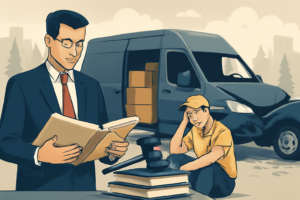
Charlotte roads can become busier in August as students return, families complete school shopping, and college residents move into dormitories and apartments. These changes can affect roads near schools, apartment communities, shopping centers, campuses, and residential neighborhoods.
Delivery activity may rise when people order:
- Desks, chairs, mattresses, and other furniture
- Computers, electronics, and school supplies
- Clothing, shoes, and dormitory items
- Groceries and household products
- Appliances and moving supplies
Drivers may need to locate unfamiliar addresses, enter crowded apartment complexes, use narrow loading zones, or stop near buildings with limited parking. A driver under route pressure may have less time to check blind spots, confirm a safe turn, or find a lawful place to stop.
Late-summer rain, wet pavement, glare, and sudden changes in traffic speed can reduce the margin for error. A driver who checks a scanner, navigation screen, dispatch message, or delivery app while moving may fail to see a stopped vehicle, cyclist, pedestrian, or changing traffic signal.
Delivery truck evidence can disappear before your injuries are fully understood. Route history, app data, delivery scans, and camera footage should be identified and preserved as soon as possible.
Attorney Paralegal
Marcel McCrea

Tylisa Crawford
Common Causes of Charlotte Delivery Truck Crashes
A delivery truck collision can happen when a driver:
- Backs from a driveway, parking space, or loading area without a clear view
- Stops suddenly in a travel lane or bicycle lane
- Parks where the vehicle blocks another driver, pedestrian, or cyclist from view
- Changes lanes late to reach an address
- Checks a phone, scanner, dispatch message, or navigation device while moving
- Makes a wide turn near another vehicle, cyclist, or pedestrian
- Drives while fatigued, distracted, or under time pressure
- Fails to secure packages, furniture, or other cargo
- Uses a vehicle with worn tires, defective brakes, or another maintenance problem
- Ignores a traffic signal, crosswalk, school-zone restriction, or right-of-way rule
A delivery vehicle does not need to be a tractor-trailer to cause severe harm. Cargo vans, step vans, box trucks, pickup trucks, rental vehicles, and personal cars used for app-based deliveries can all cause serious injuries.
I have worked and referred cases to Attorney Marcel McCrea in Charlotte, North Carolina, for a number of years. His zealous advocacy, keen attention to details, and client care are particularly noteworthy. He has been especially helpful in some complicated personal injury matters that I have referred to his firm. I highly recommend Marcel McCrea and ClearView Legal for anyone looking for excellent attorneys.” - Frantz Jacques ClearView Legal do great work. When I had my car accident they were very diligent in showing me the process. They took care of all the necessary paperwork and negotiation in my personal injury claim. They were both passionate and determined to get me my settlement. I am eternally grateful. Definitely 5 star lawyers in my book." - Osmund Marcellin I was recently injured in a car accident. I hired Attorney Marcel McCrea of ClearView Legal in Charlotte, NC to help me with my personal injury matter and to recover for my medical bills, lost wages, and pain and suffering. - S. Jackson
Before hiring the firm, I tried to negotiate with the insurance company on my own and got no where. Marcel McCrea did an excellent job and helped me to recover much more than I expected. Marcel and his staff exceeded my expectations and provided great customer service. I highly recommend the firm!"
Why Delivery Truck Claims Differ From Ordinary Car Accident Claims
A routine two-car crash often begins with two drivers and two insurance policies. A delivery truck claim may involve a longer chain of businesses, contracts, vehicle owners, and insurers.
The company name shown on the vehicle may not identify the business that owns the truck, employs the driver, controls the route, maintains the vehicle, or provides insurance coverage. The driver may be:
- A company employee
- A temporary worker
- An independent contractor
- A driver hired through a logistics company
- A gig worker using a personal vehicle
- An employee of a local delivery subcontractor
Driver classification can affect which company may be responsible and which policies may apply. A contract label does not always resolve the issue. The working relationship, level of control, delivery assignment, and conduct that caused the crash may all require investigation.
A police report can identify the driver and one insurer, but it may not reveal the full delivery relationship.
Who May Be Responsible After a Delivery Truck Accident?
Responsibility depends on the facts. Potentially responsible parties may include:
- The delivery driver
- The driver’s employer
- A delivery, courier, or logistics company
- A business that selected or supervised a subcontractor
- A vehicle owner or lessor when there is an independent legal basis for liability, such as negligent maintenance or another wrongful act
- A maintenance or repair company
- A company that loaded or secured the cargo
- A manufacturer of a defective vehicle or part
- Another driver whose conduct contributed to the collision
An employer may be responsible for an employee’s negligence when the employee was acting within the scope of the job. A company may also face a separate claim when evidence supports negligent hiring, training, supervision, maintenance, dispatch, inspection, or scheduling practices.
Federal law may limit claims against a rental or leasing company when liability is based only on vehicle ownership and the owner was not independently negligent. The exact ownership, rental, maintenance, and operating facts must be reviewed before assigning responsibility.
Insurance Coverage May Involve Several Policies
Insurance questions can become difficult when a driver uses a personal car for deliveries or works through an app. A personal auto policy may contain exclusions or restrictions for business use. A delivery platform, contractor, vehicle owner, or employer may have separate commercial coverage.
Coverage may depend on what the driver was doing at the time of the crash. Relevant questions can include:
- Was the driver logged into a delivery app?
- Had the driver accepted an order?
- Was the driver traveling to collect a delivery?
- Was the order inside the vehicle?
- Had the delivery been completed?
- Was the driver returning to a warehouse or waiting for another assignment?
- Which company controlled the route, schedule, or delivery instructions?
Do not assume that the policy listed on a police report is the only available coverage. An investigation may identify other companies, policies, or contractual insurance requirements.
Evidence That Should Be Preserved Quickly
Delivery businesses often create electronic and operational records that do not exist in a typical car accident. Some systems overwrite data automatically. A company may repair the vehicle, reassign the driver, or return the truck to service before you know which evidence matters.
Useful evidence may include:
- GPS and route-history data
- Delivery-app login records
- Dispatch messages and driver communications
- Delivery scans, timestamps, and completion photographs
- Driver schedules, time records, payroll records, and timecards
- Dashcam and in-cab camera footage
- Traffic-camera, business-surveillance, parking-facility, and doorbell footage
- Mobile phone records and device activity
- Vehicle inspection and maintenance records
- Cargo-loading and securement documents
- Driver training and disciplinary records
- Telematics and event data stored by the vehicle
- Contracts between the driver, delivery company, logistics provider, and vehicle owner
- Photographs of vehicle damage, debris, tire marks, traffic controls, and road conditions
Some federally regulated motor carriers must retain records of duty status and supporting documents for six months. That rule does not apply to every local delivery van, app-based driver, or personal vehicle. The vehicle, route, weight, and business operation must be reviewed before anyone assumes which federal rules apply.
FMCSA record-retention guidance is available at https://www.fmcsa.dot.gov/hours-service/elds/how-long-must-motor-carriers-retain-records-duty-status-rods-and-supporting.
A preservation notice can identify records connected to the driver, vehicle, route, delivery assignment, and collision. Early action can reduce the risk that relevant evidence will be lost through routine deletion, repair, or reassignment.
Common Injuries After a Delivery Truck Collision
The size, weight, and shape of a delivery vehicle can affect the force and direction of a collision. A crash may cause:
- Broken bones
- Traumatic brain injuries
- Neck and spinal injuries
- Shoulder, knee, and joint injuries
- Internal injuries
- Cuts and scarring
- Nerve damage
- Soft-tissue injuries
- Psychological trauma
Some symptoms begin at the scene. Others may develop over several hours or days. Headaches, dizziness, stiffness, numbness, abdominal pain, weakness, memory problems, or changes in concentration deserve medical attention.
Prompt evaluation protects your health and creates medical documentation close in time to the crash. Follow treatment instructions, attend scheduled appointments, and report new or worsening symptoms to your medical providers.
What to Do After a Charlotte Delivery Truck Accident
Your safety and health come first. Move away from traffic when you can do so safely, call 911, and request medical help when needed. Do not assume that a low-speed collision cannot cause a serious injury.
When your condition allows:
- Photograph the delivery vehicle, license plate, unit number, company markings, damage, roadway, traffic controls, debris, and nearby businesses.
- Record the driver’s name, employer, insurance information, vehicle owner, and any delivery company shown on the truck, uniform, package, paperwork, or app.
- Photograph any United States Department of Transportation number or other identifying number displayed on the vehicle.
- Ask witnesses for their names, telephone numbers, and email addresses.
- Save delivery notices, app messages, order confirmations, doorbell footage, or other records that may identify the route or company.
- Keep copies of medical records, bills, prescriptions, work notes, repair estimates, rental expenses, and treatment-related mileage.
- Track missed work, reduced income, transportation costs, and assistance you need at home.
- Avoid guessing about speed, distance, visibility, or fault when speaking with an insurer.
- Do not sign a release before you understand your injuries, treatment needs, and available insurance coverage.
- Avoid posting crash details, photographs, or activity updates on social media while the claim is pending.
A police report can provide useful information, but photographs, video, electronic data, witness accounts, and vehicle damage may provide a fuller view of what occurred.
How North Carolina Contributory Negligence Can Affect a Claim
North Carolina recognizes contributory negligence as a defense. Under North Carolina General Statute 1-139, the party asserting that defense has the burden of proving it.
Official statute: https://www.ncleg.gov/EnactedLegislation/Statutes/PDF/BySection/Chapter_1/GS_1-139.pdf
An insurer or delivery company may argue that your conduct contributed to the crash. It may claim that you were speeding, following too closely, passing unsafely, entering a blind spot, failing to yield, or not reacting soon enough.
A pedestrian or cyclist may face arguments about visibility, traffic controls, lane position, or right of way. Photographs, video, witness accounts, route data, delivery timestamps, and vehicle positions can help test those claims.
An insurer’s accusation does not decide fault. The analysis depends on the full evidence and the legal rules that apply to the specific collision.
For more information about commercial collision claims, visit:
- https://clearview.legal/charlotte-truck-accident-attorneys/
- https://clearview.legal/charlotte-car-accident-lawyers/
What Compensation May Be Available?
A valid delivery truck accident claim may seek compensation for losses caused by the collision, including:
- Emergency care, hospitalization, surgery, therapy, medication, and future treatment
- Lost wages and reduced earning capacity
- Pain, physical limitations, emotional distress, and loss of normal activities
- Scarring, disability, or permanent impairment
- Property damage, rental costs, and transportation expenses
- Reasonable costs for household assistance made necessary by the injury
The value of a claim depends on liability, medical findings, recovery time, work effects, future needs, insurance coverage, disputed fault, and the strength of the evidence. A responsible attorney cannot promise a result before reviewing the facts.
How Long Do You Have to File a Claim?
North Carolina General Statute 1-52 generally provides a three-year limitations period for many negligence-based personal injury and property-damage actions.
Official statute: https://www.ncleg.gov/EnactedLegislation/Statutes/HTML/BySection/Chapter_1/GS_1-52.html
Wrongful death actions generally have a two-year filing period measured from the date of death under North Carolina General Statute 1-53.
Official statute: https://www.ncleg.gov/EnactedLegislation/Statutes/PDF/BySection/Chapter_1/GS_1-53.pdf
Different deadlines, notice requirements, or filing procedures may apply when a government vehicle, a minor, or another special circumstance is involved. You should obtain legal advice based on the facts of your case.
A filing period does not make delay harmless. Surveillance footage may be erased within days or weeks. Electronic delivery records may be overwritten. Vehicles may be repaired. Witnesses may move or forget details. Early investigation can help identify the correct companies and insurance carriers while evidence remains available.
How a Charlotte Delivery Truck Accident Lawyer Can Help
A lawyer can investigate the crash, identify business relationships, preserve electronic records, review insurance policies, interview witnesses, obtain maintenance documents, and connect medical evidence to the collision.
An attorney can also:
- Determine whether the driver was an employee, contractor, or app-based worker
- Identify the owner, lessee, and operator of the vehicle
- Review delivery contracts and insurance requirements
- Request route, dispatch, scan, and app data
- Evaluate personal and commercial insurance coverage
- Handle communications with insurance adjusters
- Document present and future losses
- Evaluate settlement proposals
- Prepare a lawsuit when negotiation does not resolve the claim
Related ClearView Legal resources:
- https://clearview.legal/charlotte-truck-accident-attorneys/
- https://clearview.legal/charlotte-car-accident-lawyers/
- https://clearview.legal/charlotte-personal-injury-attorneys/
- https://clearview.legal/charlotte-attorney-marcel-mccrea/
Speak With ClearView Legal After a Charlotte Delivery Truck Accident
A delivery truck crash can leave you managing medical care, missed income, vehicle damage, and calls from several insurers. ClearView Legal offers free consultations and can review how the collision happened, identify evidence that may need prompt preservation, and explain the legal options that may apply.
The firm serves injured people in Charlotte, Mecklenburg County, and nearby North Carolina communities. ClearView Legal emphasizes consistent, clear, and candid communication while evaluating each case based on its facts.
Call (980) 300-6223 or contact the firm at https://clearview.legal/contact-us/.
This article is for informational purposes only. It is not legal advice, does not create an attorney-client relationship, and does not predict the outcome of any claim. Consult an attorney about your specific situation.

 |
 |