
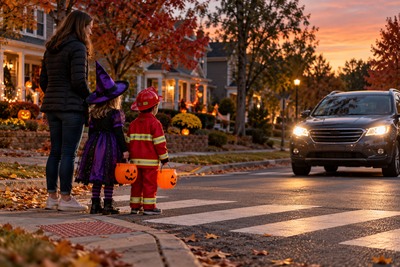
Halloween can put more pedestrians on neighborhood streets, sidewalks, driveways, parking areas, and intersections after dark. If you are hit by a vehicle while walking in North Carolina, liability generally depends on who failed to use reasonable care and whether that conduct caused your injuries.
A driver may be responsible for speeding, distraction, failing to yield, impaired driving, or backing without checking for pedestrians. In other cases, a commercial driver’s employer, rideshare driver, property owner, business, or another negligent party may share responsibility.
Your own actions can also become part of the liability analysis because North Carolina applies contributory negligence rules in many personal injury cases.
ClearView Legal represents injured people in Charlotte, North Carolina, and nearby areas. Halloween pedestrian crashes can involve unusual circumstances, including children crossing residential streets, costumes that affect visibility, parked vehicles blocking sight lines, delivery traffic, rideshare vehicles, and drivers who do not adjust their speed or attention to crowded neighborhoods.

Who Can Be Liable for a Halloween Pedestrian Accident?
There is no single answer for every Halloween pedestrian accident. Liability depends on how the collision happened, who had a legal duty to act carefully, and whose conduct contributed to the crash.
Potentially responsible parties may include:
A negligent driver
A commercial driver’s employer
A rideshare driver
A delivery driver
A property owner in certain circumstances
A business responsible for a dangerous property condition
More than one negligent person or organization
The investigation often starts with what the driver and pedestrian were doing immediately before the collision.
Key point: Halloween does not change North Carolina negligence law, but the conditions surrounding Halloween can affect whether a driver or another party acted reasonably.

Marcel McCrea
Attorney

Tylisa Crawford
Paralegal
When Can a Driver Be Liable for Hitting a Pedestrian?
Drivers must operate their vehicles with reasonable care under the circumstances. Halloween can create conditions that require heightened attention because residential neighborhoods may contain more children, families, parked vehicles, and people crossing streets after dark.
A driver may potentially be liable when a pedestrian collision results from conduct such as:
Speeding through a residential neighborhood
Texting or using a mobile device while driving
Failing to watch for pedestrians
Driving while impaired
Failing to yield at a crosswalk
Turning without checking for pedestrians
Backing out of a driveway without checking carefully
Driving too fast for lighting, visibility, traffic, or roadway conditions
North Carolina law requires drivers to yield to pedestrians in marked crosswalks and in certain unmarked crosswalks at intersections when traffic signals are not controlling the crossing.
Drivers entering or leaving driveways, alleys, buildings, or private roads also must yield to pedestrians using an adjoining sidewalk or walkway.
That rule can be particularly relevant on Halloween. If a driver is backing out of a driveway while children and families are walking along the sidewalk, the driver may need to stop and carefully check the surrounding area before entering the roadway.
North Carolina law also requires drivers to exercise due care to avoid colliding with pedestrians. Drivers must take proper precautions when they observe children or confused or incapacitated people on or near the roadway.
For more information about pedestrian injury claims in Charlotte, visit:
https://clearview.legal/charlotte-pedestrian-accident-attorneys/
Can Pedestrian Conduct Affect Liability?
Yes. Pedestrians also have responsibilities under North Carolina law.
A pedestrian crossing a roadway outside a marked crosswalk or outside an unmarked crosswalk at an intersection generally must yield to vehicles traveling on the roadway.
Between adjacent intersections where traffic-control signals are operating, pedestrians generally must use a marked crosswalk.
Questions that may become relevant after a Halloween pedestrian accident include whether you:
Entered the roadway suddenly
Crossed between parked vehicles
Crossed outside a crosswalk
Followed pedestrian traffic signals
Were distracted by a mobile device
Could see approaching traffic
Were visible to the driver
Gave the driver enough time to react
None of these facts automatically decides liability by itself.
Even if you crossed somewhere other than a crosswalk, the driver’s conduct must still be examined. Relevant evidence may include the driver’s speed, lighting conditions, traffic, sight distance, reaction time, vehicle position, and whether the driver should reasonably have anticipated pedestrians nearby.
For example, a child wearing a Halloween costume may enter a residential street from between parked vehicles. An insurance company may argue that the child entered the roadway unexpectedly.
The investigation should also examine whether the driver was traveling too fast, whether visibility was limited, whether the neighborhood was crowded with trick-or-treaters, and whether the driver had enough time to reduce speed or avoid the collision.

I have worked and referred cases to Attorney Marcel McCrea in Charlotte, North Carolina, for a number of years. His zealous advocacy, keen attention to details, and client care are particularly noteworthy. He has been especially helpful in some complicated personal injury matters that I have referred to his firm. I highly recommend Marcel McCrea and ClearView Legal for anyone looking for excellent attorneys.”
- Frantz Jacques
ClearView Legal do great work. When I had my car accident they were very diligent in showing me the process. They took care of all the necessary paperwork and negotiation in my personal injury claim. They were both passionate and determined to get me my settlement. I am eternally grateful. Definitely 5 star lawyers in my book."
- Osmund Marcellin
I was recently injured in a car accident. I hired Attorney Marcel McCrea of ClearView Legal in Charlotte, NC to help me with my personal injury matter and to recover for my medical bills, lost wages, and pain and suffering.
Before hiring the firm, I tried to negotiate with the insurance company on my own and got no where. Marcel McCrea did an excellent job and helped me to recover much more than I expected. Marcel and his staff exceeded my expectations and provided great customer service. I highly recommend the firm!"
- S. Jackson
How Does North Carolina Contributory Negligence Affect a Pedestrian Claim?
North Carolina follows a contributory negligence rule in many personal injury cases.
Under this doctrine, evidence that an injured person failed to use reasonable care may become a major issue in determining whether that person can recover compensation.
This makes the details of a pedestrian accident especially important.
An insurance company may closely examine:
Where you crossed the roadway
Whether you used a crosswalk
Whether you followed traffic signals
Whether you saw the approaching vehicle
Whether you were distracted
Whether you could have avoided the collision
What the driver could see before impact
Crossing outside a crosswalk does not automatically mean that you caused the accident. The driver’s conduct and the complete circumstances still matter.
Because North Carolina’s contributory negligence doctrine can significantly affect a claim, evidence showing how the crash occurred may be critical.
How Is Contributory Negligence Different When a Child Is Injured?
Cases involving children require additional analysis.
North Carolina courts do not always evaluate a child’s conduct under the same standard applied to an adult.
Children under seven are generally presumed incapable of contributory negligence.
For children between seven and fourteen, North Carolina law generally recognizes a rebuttable presumption that the child was incapable of contributory negligence. The specific facts can affect how that presumption applies.
Age, maturity, experience, surrounding conditions, and the child’s conduct may all become relevant.
This issue can be especially significant in Halloween accidents because children may be crossing streets, walking between parked vehicles, or moving through neighborhoods after dark.
Can an Employer Be Responsible for a Halloween Pedestrian Accident?
A Halloween pedestrian accident may involve a person who was driving as part of their job.
Examples can include:
Delivery drivers
Service technicians
Commercial vehicle drivers
Employees traveling between work locations
Employees making business-related stops
When an employee negligently causes an accident while acting within the course and scope of employment, the employer may sometimes be legally responsible for the employee’s conduct.
Whether an employer can be held responsible depends on the driver’s employment relationship and what the driver was doing when the collision occurred.
Evidence may include:
Work schedules
Delivery records
Dispatch records
Vehicle ownership documents
Electronic communications
Employment records
Insurance policies
GPS or route information
A claim involving a commercial driver may also involve different insurance policies and additional evidence that would not exist in an ordinary passenger-vehicle accident.
For information about Charlotte vehicle accident claims, visit:
https://clearview.legal/charlotte-car-accident-lawyers/
What If a Rideshare Driver Hits a Pedestrian?
Halloween can increase rideshare activity because people may use Uber, Lyft, and similar services to travel to parties, restaurants, events, and residential neighborhoods.
If a rideshare driver strikes you, insurance coverage may depend partly on what the driver was doing within the rideshare application when the collision occurred.
Relevant questions may include whether the driver was:
Logged into the rideshare application
Waiting for a ride request
Traveling to pick up a passenger
Transporting a passenger
Using the vehicle for personal purposes
North Carolina law imposes different insurance requirements depending on the driver’s rideshare status.
Determining that status can help identify which insurance coverage may apply.
More information about these claims is available at:
https://clearview.legal/charlotte-rideshare-accident-attorneys/
Can a Property Owner Share Responsibility for a Pedestrian Injury?
Some Halloween pedestrian injuries involve more than the actions of a driver.
A dangerous condition on private property may contribute to a collision or other pedestrian injury.
Examples may include:
Poor lighting
Blocked walkways
Unsafe parking areas
Obstructions that interfere with visibility
Conditions that force pedestrians toward moving vehicles
Property owner liability is not automatic.
A claim generally requires evidence concerning the dangerous condition, the responsible party’s legal duty, notice of the condition when required, and whether the condition contributed to your injury.
A pedestrian accident at an apartment community, shopping center, organized Halloween event, parking area, or commercial property may require investigation of both driver conduct and property conditions.
What Evidence Can Help Establish Fault After a Halloween Pedestrian Accident?
Halloween accident scenes can change quickly.
Decorations may be removed. Parked vehicles may move. Witnesses may leave. Businesses and homeowners may overwrite surveillance footage.
Evidence worth preserving may include:
Photographs of the roadway
Photographs of the surrounding area
Crosswalk locations
Traffic signals and signs
Street lighting conditions
Nearby parked vehicles
Photographs of clothing or costumes
Vehicle damage
Police reports
Witness names and contact information
Doorbell camera recordings
Business surveillance footage
Dash camera footage
Cell phone records when distraction is suspected
Rideshare records
Delivery records
Medical records
Medical bills
Lost-wage documentation
Preserving evidence early can make it easier to determine how the collision happened and who may be legally responsible.
For more information about North Carolina personal injury claims, visit:
https://clearview.legal/charlotte-personal-injury-attorneys/
What Compensation May Be Available After a Pedestrian Accident?
If another party is legally responsible for your pedestrian accident, you may be able to pursue compensation for losses caused by the collision.
Depending on your circumstances, damages may include:
Emergency medical treatment
Hospital expenses
Surgery
Rehabilitation
Physical therapy
Future medical treatment
Lost wages
Reduced earning capacity
Pain and suffering
Permanent impairment
Scarring
Disfigurement
The value of a pedestrian accident claim depends on the facts of the case.
Relevant factors can include the severity of your injuries, medical treatment, expected recovery, permanent limitations, lost income, insurance coverage, and evidence showing who caused the accident.
Pedestrians can suffer serious injuries because they have little physical protection when struck by a moving vehicle.
Medical documentation may help establish the nature of your injuries, the treatment you received, and whether you may require future care.
What Happens If a Halloween Pedestrian Accident Is Fatal?
Some pedestrian collisions result in fatal injuries.
When a death is caused by another person’s wrongful act, neglect, or default, eligible family members or representatives may have rights under North Carolina wrongful death law.
Wrongful death claims involve legal and procedural issues that differ from ordinary personal injury cases.
Potential damages can depend on the circumstances of the death and the losses recognized under North Carolina law.
Families can learn more at:
https://clearview.legal/charlotte-wrongful-death-attorneys/
How Long Do You Have to File a Pedestrian Accident Lawsuit in North Carolina?
North Carolina generally applies a three-year statute of limitations to many personal injury actions.
That does not mean every pedestrian accident case has the same deadline.
Different rules may apply depending on:
The type of legal claim
The parties involved
The age of the injured person
Whether a government entity is involved
Whether the accident resulted in death
Other facts affecting the claim
Wrongful death claims generally involve a different limitations period than personal injury claims.
Waiting can also make an investigation more difficult even when the filing deadline has not expired.
Surveillance footage may be erased. Witnesses may become difficult to locate. Vehicles may be repaired. Road conditions can change.
Addressing the case early can help preserve evidence that may later become important.
What Should You Do After a Halloween Pedestrian Accident?
Your health should be your first concern.
Seek appropriate medical attention after a pedestrian collision, even if you are uncertain about the extent of your injuries.
After your immediate medical needs have been addressed, useful steps may include:
Report the accident to law enforcement
Photograph the scene
Photograph your injuries when appropriate
Identify witnesses
Preserve damaged clothing and personal items
Save medical records and bills
Keep records of missed work
Save communications with insurance companies
Preserve photographs, videos, and electronic evidence
Use care when an opposing insurance company asks you to provide a detailed recorded statement.
An insurer may ask where you were walking, whether you used a crosswalk, what you were wearing, whether you saw the vehicle, and when you first noticed the driver.
Those details may later become part of a dispute concerning contributory negligence.
Talk With a Charlotte Pedestrian Accident Attorney
A Halloween pedestrian accident can leave you dealing with medical treatment, missed work, insurance questions, and uncertainty about who caused the crash.
ClearView Legal helps injured people in Charlotte, North Carolina, and nearby areas evaluate pedestrian accident claims and understand how North Carolina liability rules may affect their ability to pursue compensation.
The firm offers initial consultations at no charge.
To contact ClearView Legal, visit:
https://clearview.legal/contact-us/
This article is for informational purposes only and does not constitute legal advice. You should consult an attorney about the facts of your specific situation.